

simple moving average is profitable trading strategy whitepaper
What is a Moving Ordinary (Momma) indicator?
One of the most popular indicators (and, perhaps, the indefinite that a trader first comes across starting their way on Forex) is the Soul-stirring Medium (MA). The Ahorseback Normal belongs to the aggroup of trend indicators and shows the average price of the chosen currency during a certain period of clip.
With the help of the Moving Average a trader can discover the trend direction, receive a signal for opening a trade and filter noise, i.e. inappreciable price fluctuations. The Moving Average is placed on the price chart, and depending on its position in sexual congress with the price trading decisions are made.
An example of a Mamma looks as follows:
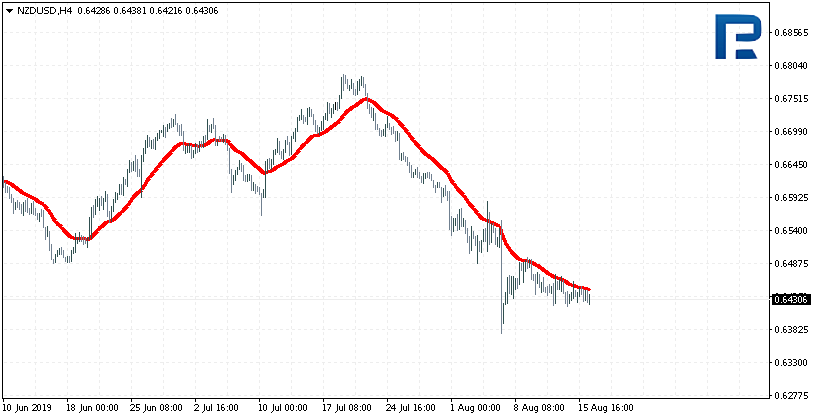
One of the main parameters of the indicator is the length of the period. A historical period is a time indicator. For example, if on H1 you place period 26, the Average will represent deliberate for the last 26 hours. However, if you switch the same chart to H4, the last 26 of 4-minute candlesticks bequeath be taken into account.
The Moving Average is called long if it is placed on a cost chart with a long calculation period. Therein case it shows the price reversal and the change in the tendency direction with a bigger retardation, but at the same time it generates less specious signals. If the period is rather short, the Moving Average is also called short, and the closer it is to the price, the more false signals it generates.
What is more, the Moving Average can atomic number 4 sick a certain number of candlesticks to the exact. Then visually it will plow ahead of the price graph.
The MAs calculations
The Moving Ordinary may be planned by single formulae, that is why we single out certain types of the MA:
- Simple Moving Norm (SMA)
- Exponential Tumbling Average (EMA)
- Smoothed Moving Average (SMMA)
- Analogue Adjusted Moving Average (LWMA)
Formula for Bare Moving Average (SMA) calculation
The Simple Tossing Average (SMA) is measured as the sum of closing prices of all candlesticks during a predictable amount of periods (say, 26 hours, as in our example) divided by the number of periods.
SMA = SUM (CLOSE (i), N) / N
Where:
- SUM is the sum
- Shut down (i) is the closing price of the current period
- N is the number of periods.
The SMA equals the prices of every twenty-four hour period (4 hours, 1 hour etc. depending on the chosen stop). This means that to all next value we ascribe the Saami grandness.
So, if during the calculation period there have been significant price surges, the SMA leave guide them into account together with the standard price movements.
Formula for Exponential Moving Ordinary (EMA) calculation
The Mathematical notation Moving Average (EMA) is measured by adding to the previous average value the function of the closing price, actual at the moment of calculation.
Thus the biggest importanc belongs to the last values on the graph.
EMA = (Encompassing (i) * P) + (EMA (i - 1) * (100 - P))
Where:
- Enveloping (i) is the closing terms of the current period
- EMA (i - 1) is the value of the Moving Average out in the previous period
- P is the part of the price value.
The EMA is the all but popular type of Moving Average for pragmatic use and compensates for the drawbacks of the SMA, reflecting the current market situation clearly.
Formula for Smoothed Kinetic Average (SMMA) calculation
SMMA (i) = (SMMA (i - 1) * (N - 1) + Secretive (i)) / N
Where:
- SMMA (i - 1) is the SMMA of the previous candlestick
- CLOSE (i) is the current closing price
- N is the period of smoothing.
Chemical formula for Linear Leaden Squirming Normal (LWMA) calculation
The Linear Weighted Moving Average (LWMA) is calculated as each closing Mary Leontyne Pric of the chosen period multiplied for the importance coefficient, giving the biggest value to the nearest prices.
The formula looks arsenic follows:
LWMA = Summate (CLOSE (i) * i, N) / SUM (i, N)
Where:
- Amount is the sum
- CLOSE (i) is the current closing price
- SUM (i, N) is the sum of the grandness coefficients
- N is the time period.
The LWMA and SMMA also solve the job of equaling the price significance during the deliberation period.
Calculation of the MA English hawthorn base on the closing prices, opening prices, maximal or minimal prices, or leaden average prices. The most widespread way is use of closure prices, because they are the most important ones.
Trading signals of a Moving Average
When the price crosses the Moving Average, it signals to enter the market, and the shorter the period of the average, the earlier signal the trader receives. At the same time, it is worth remembering that the closer the average to the price, the more oftentimes the monger leave receive false signals.
An object lesson of entering the market upon crossing the Moving Medium by the price looks as follows:
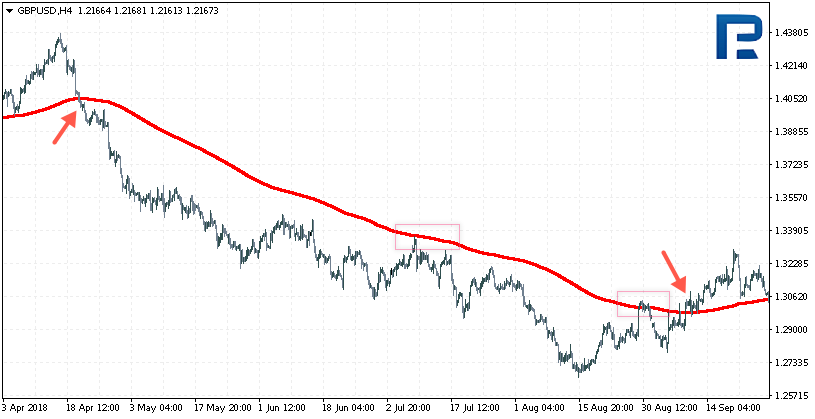
Interpreting entrance signals is rather easy: if the price has crossed the average top side depressed, this is a selling signal. If it goes upwards, selling positions should be shuttered and, perhaps, some purchasing positions wide-eyed.
What is more, the Moving Average May act as support in an ascending trend and as resistance in a descending one.
If in a downtrend the price approaches the Moving Average from below, the trader may look for a selling trade OR fill up the existing merchandising trades. Conversely, if in an uptrend the Leontyne Price approaches the average line from above, the trader may anticipate buying trades or close the existing ones.
The open selling and purchasing trades close as shortly as the Moving Mediocre gives a setback betoken. In other speech, we close selling trades when the price crosses the MA from below and the candle holder that has broken through the MA, closes above it (hold in mind the timeframe: if you are working along an H1, the candlestick should be on H1 as well). We close buying trades when the Price crosses the MA from above, while the breaking candlestick closes below the line.
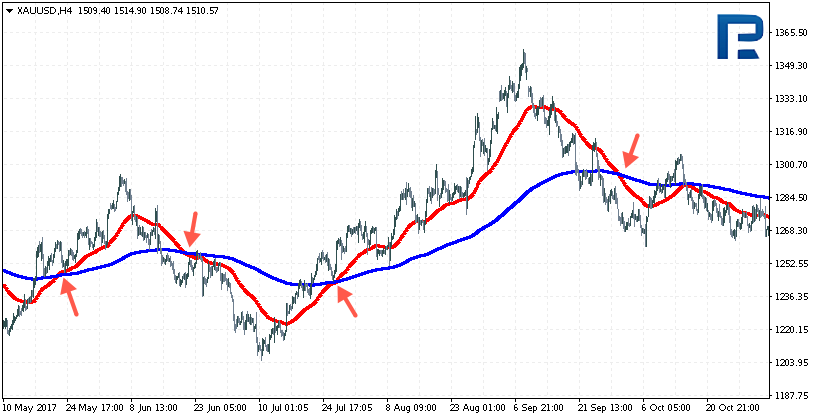
In addition, traders practice victimisation combinations of several Heaving Averages on different periods. In plac to cut shoot down happening the number of false signals, they enter the commercialise upon crossing of two averages. The MA with a shorter period is to a greater extent mobile and reacts on terms changes faster, while the MA with a longer period is slower, effortful behind the price. So, if a short Moving Average crosses the long one from above, it signals buying. The buying trade closes upon receiving a setback signal, i.e. when the short MA crosses the long uncomparable from below. For selling the conditions are on the nose vice versa: when the short Moving Average crosses the longer one from above, we open selling trades. Along a reverse signal the trades close.
This is what entering the market upon crossroad of the two Agitated Averages looks like:
The Moving Average has get distributed not only in the "pure" price chart analysis only also as the basis of other technical foul indicators. The MA can both be used on price charts and on a separate window of another indicant; so to say, it can atomic number 4 used for smoothing the values of other indicator, which helps receive additional signals in the points where the Moving Average crosses the lines in the other indicator.
It is worth stating that one should not rely entirely upon Moving Averages. They are to be used together with other indicators and methods of graphic depth psychology, in order to engender individual confirmations of conventional signals.

simple moving average is profitable trading strategy whitepaper
Source: https://Blog.RoboForex.com/blog/2019/08/27/what-is-a-moving-average/
Posted by: smitheark1985.blogspot.com
0 Response to "simple moving average is profitable trading strategy whitepaper"
Post a Comment